Showing posts with label Structures. Show all posts

Thursday, January 18, 2018

Changes to Structures

The dev blog about Upwell Structures 2.0 is a great read full of some good changes. My absolute favourite is this:
A new icon has been added to structure brackets in the overview and space scene to indicate whether you currently have permission to dock in that structure. This indication will make it much easier to determine which of the structures on a grid are open to you. It is however important to remember that even if one of your characters has permission to dock in a structure, that doesn’t mean that your other characters necessarily have the same permissions.

Finally!

Tuesday, March 28, 2017

Crystal Ball - The End is Nigh For POS

Last week I talked about how the new Refinery structures from Upwell Consortium are probably the last major dockable structure coming intended to replace Outposts and Player Owned Stations (aka POSes). However, that statement was not 100% accurate. Yes, Outposts are effectively obsolete with the growing functionality of Citadels and Engineering Complexes, but while Refineries cover a large portion of the outstanding functionality currently provided by POSes, there are still three very important functions that are not covered:

- Cynosural Generator Arrays (aka cyno beacons)

- Cynosural System Jammers

- Jump Bridges

Each of these is a starbase modules that gets anchored and onlined at the POS and provides important functionality to pilots of the owning corporation/alliance.

Cyno beacons act as permanent cynosural fields like what is generated on ships that allow ships with jump drives to transit to that system. These are hugely more useful than using another pilot because they are always on, don't require other pilots, and are anchored near a starbase for some automated defense (but don't count on it to save you in the face of a determined opponent).

Cyno jammers are modules installed near a starbase that prevents any normal cyno fields from being generated (covert cynos can still be lit) in the system.

And jump bridges are modules installed near a starbase that allow instant passage from one system to another system in range with a paired jump bridge module. The module requires liquid ozone fuel in it to allow passage (the amount determined by the mass of the ship using it) but this module is support important for null sec alliances who want to shape their space and gain a huge mobility advantage for them and their allies over enemy fleet in the same space.

An important part of the operation of these three modules are that all of them have to be active outside the starbase's force field, meaning a hostile force can attempt to disable the modules to deprive their functionality to the owners, indeed some serious battles in null sec erupt and/or turn around these modules being forced offline or preventing that from happening.

So when POSes go away, how will CCP implement something to replace these items?

For the two cyno related items there are several possibilities each with their own issues. The simplest approach would be to make two new structure modules that require fuel, much like the manufacturing modules or clone bay module, but can only be installed in Citadels (i.e. not Eng Plexes or Refineries). Installing and activating the cyno beacon/jammer would enable the citadel for the appropriate role. However, the downside is that the durability and invulnerability of the citadel now applies to the module, safely ensconced in the bowels of the structure. This would remove the option of an attacking force disabling the jammer/beacon without destroying the entire structure. So that's no good.

A second option would be to keep the POS modules similar to how they are now, but change the code to only allow them to be anchored in the vicinity of a citadel. Their fuel cost for being online would go into the fuel cost of the structure, they would still be attackable since they are not inside the structure, and the citadel's weapons could be used to provide some protection for them... but since the structure weapons are not automated it would be only if there was someone at the controls, meaning it would be much easier for attacking forces with even a few small ships to disable the modules.

Finally, CCP could make new small structures independent of citadels, larger and more permanent than mobile depot and portable cyno jammers but much smaller than citadels. They would not have docking but would have a fuel bay, a few automated weapon systems, maybe even vulnerability windows but much larger than Raitaru Eng plexes (like 12 hours a day). They could have the same anchoring limitations as the other Upwell structures to prevent them from being used as extra firepower around stations or gates. This option would solve the too-invulnerable and too-vulnerable issues of the other two options but requires a lot more coding development work from CCP.

For the final POS module, the jump bridge array, I think a new structure with new rules is mandatory to make it work. Right now jump bridges are only allowed in sov null sec but I think that we can open the functionality up both in how and where its used. And tick off a roadmap checkbox for CCP's long term plans.

Allow players to build stargates.

(I realize I'm putting on my crazy dreamer development hat here, but go with it.)

There would be three sizes: medium, large, and extra large and each gate would have similar build costs to citadels. Each size has different levels of defensive capabilities, vulnerability windows, and fuel cost, again similar to citadels.

Docking? No, can't dock at them. They have fuel bay and perhaps some method of opening a fitting window.

In order to actually be a stargate and allow passage, they have to be paired with the same sized stargate owned by the same corporation in another system within range: the larger the stargate the longer the maximum range. Right now I'm think the max range of the extra large should be around 8 light years, large at 5 light years (current jump bridge max range), and medium at 2-3 light years.

They would show up on the overview (same functionality as other Upwell structures) but access to using them is defined by an access control list (ACL). They may have an ISK cost for using them defined by the owning corporation via the ACL.

They can be placed in any non-Wormhole space like other Upwell structures, but only one active online stargate allowed per system! HUGE gamechanger, I know, but they can be attacked and destroyed like any other Upwell structure so yes you can build a new public toll road to avoid Udema when travelling from Jita to Amarr but you can be wardecced and attacked for it.

God I would love to see this.

Thursday, March 23, 2017

The End of Passive Aggressive Income

Yesterday CCP introduced the final of the trio of new Upwell structures that will replace Outposts and Player-Owned Starbases: Refineries.

Refineries will come in medium and large sizes with prices between that of Engineering Complexes and Citadels. Like the earlier Upwell Structures they will have docking and tethering ability as well as the whole suite of standard structure features like storage, fitting, insurance, repair and corp offices. They will be able to fit the same set of basic Standup modules as Citadels and Engineering Complexes. As we continue to add more features to the basic Upwell framework both before and after the release of Refineries they will gain those upgrades as well. The benefits of the larger sized Refinery will primarily come from increased defenses, more generalized rigs and increased docking capabilities, with all the core Refinery functionality available in both Medium and Large versions.
Refineries are intended to be the hub of resource collection and resource processing operations. At launch these operations will largely revolve around reprocessing ore, mining moons, and reacting advanced materials together to create composites. In the future we will continue to look for opportunities to tie more resource collection and processing functions to these structures. For instance, mining buffs and support roles provided by the structure are not out of the question over the medium-term, and we are interested in investigating the possibility of shifting the sov mining upgrade role from Infrastructure Hubs to Refineries eventually.
What's really interesting is the new mechanic that will replace current moon mining:

Here’s a walkthrough of the process currently planned for the new moon mining system:
1. A refinery that is deployed close enough to a moon can fit a special moon drilling service module. Fitting of this module will only be an option if no other drills are fit to other Refineries around the same moon, so only one structure can mine each moon at a time. This service module gives the owners the ability to designate how large of a fracking operation they wish to begin, with larger chunks taking longer time to prepare.
2. The moon drilling module begins blasting a chunk of the moon away from its surface and dragging it towards the structure. This process takes between one and several weeks depending on the choices made by the structure owner. Observers can watch the chunk move through space as a way of estimating when it will reach the Refinery.
3. Once the chunk of moon rock has completed its journey into space, the Refinery can use its drill module to detonate the chunk into a minable asteroid field. The exact time of the detonation is controlled by the owners of the Refinery within limits. If the chunk is left unattended long enough it will disintegrate into the asteroid field on its own.
4. The new asteroid field that appears with the explosion of the chunk will contain new types of valuable ores that will yield moon minerals when reprocessed. The composition of the field will depend on the composition of moon materials available in the moon. The field will generally remain far enough away from the Refinery structure that you won’t be able to effectively mine it from docking range but close enough for a pilot controlling the Refinery to be able to cover the friendly miners and/or attack uninvited guests.
5. Once the chunk has exploded, the drilling module can begin fracturing a new part of the moon to start the process again.
The time scale for this whole cycle will be controllable by the owners of the Refinery, within constraints. Longer cycle times will mean more ore generated in each explosion.
This is a fascinating and fundamental change. Let's call the POS moon extraction technique "moon mining" and the Refinery technique "moon fracking".

Moon mining can be an extremely lucrative activity for a corporation or alliance to engage in, but tends to be a) mostly passive and b) run by a small number of people in the organization. Once a POS is setup and the moon extracting modules running with the correct silos connected, the operation becomes one of moving extracted materials around, setting up reactions, transporting to market, and ensuring fuel levels of the tower are maintained. Overall, not a lot of people required.

Moon fracking, on the other hand, still has the setup of the Refinery and onlining of the module, but the actual resource gathering step will require a mining fleet in order to gather the extracted moon minerals from the newly formed asteroid field. Suddenly the operation has to leave the safe confines of a force field and venture out into space to get those valuable ores. Suddenly the process requires other people working together. Suddenly its possible to disrupt a moon mining operation without having to reinforce a tower.

This dramatic shift means that one of the pillars of a successful alliance / coalition, i.e. a dependable income stream that is difficult to disrupt without a large scale attack, is now more exposed to outside interference and requires more members of the organization working together to accomplish what a small number did before. This will make it easier to topple organizations from without (attacking the miners) and from within (low participation).

If I were in a large coalition right now, I'd be making plans on how to put the incentives in place to get pilots into these moon fracking cleanup fleets.

Thursday, February 09, 2017

Structure Losses

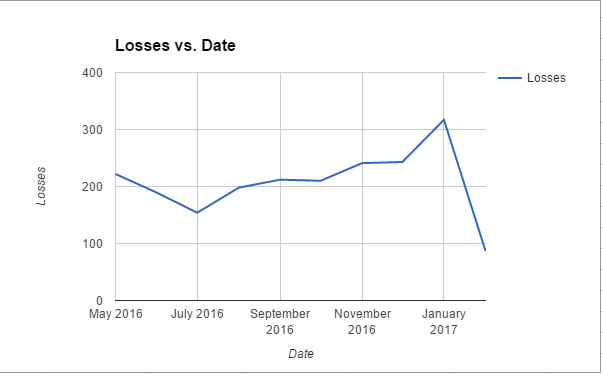
Out of curiosity I went to Zkillboard and brought up the statistics for Citadels (which covers Astrahus, Fortizar, Keepstars, and Palatine Keepstar) and looked at the losses since they were introduced last year in May.


I suspect the initial surge was people getting the hang of the structures during the rush to deploy them, and the slow climb is the attrition of existing structures getting destroyed over time as their population grows and they figure more and more into wars in all parts of space. The latest spike seen in January could be due to the current Winter War down in the south.

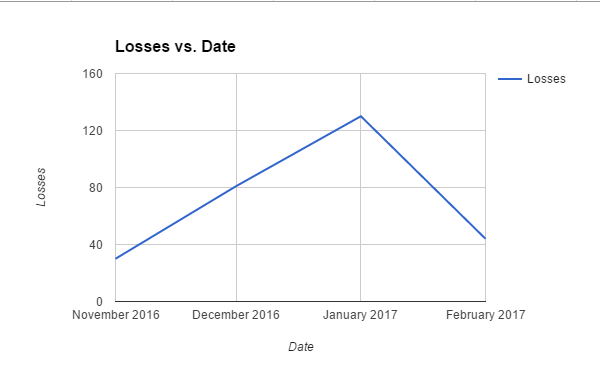
As for Engineering Complexes, they have not been around long enough to derived any conclusions but included here for completeness:
It is interesting that the numbers are so low for December and January compared to citadels despite being less defensible than them. This could be due to them being used more cautiously than citadels which often get deployed as forward operating bases, or maybe there are far fewer of them deployed since they are more specific to industry and people just looking for homes use citadels instead.

Remember, purchase Ninveah Enterprises structures found in Dodixie, manufactured with care and love!

Friday, October 14, 2016

Raitaru, Raitaru, Wherefore Art Thou?

So let's talk more about Engineering Complexes.

We got more details on the structures in a dev blog earlier this week titled Building Dreams: Introducing Engineering Complexes. These are the structures intended to replace the manufacturing and science capabilities of Outposts and POS arrays, up to and including the production of Super capitals (with appropriate sov control of course for the latter). They have a lot of similarities to Citadels including asset safety, docking, corporate hangers, vulnerability windows, reinforcements, etc. On the other hand, they have lower build requirements thus lower costs; for example, a medium Astrahus citadel costs about 1 billion ISK to produce while the corresponding medium Raitaru will run around 700 million ISK at the same material prices. They also have longer vulnerability windows (3 hours for Astrahus, 9 hours for Raitaru), and tighter docking restrictions: the Large EngPlex can build and launch capitals but can't dock them like the large Citadel can, and similar situation with XLarge and super capitals. Related: the Medium Raitara cannot build capitals.

There is no word on the BPO costs yet, but assuming they follow the same price differential ratio as the structures themselves, I expect the medium BPO to be about 5 billion, large ~50 billion, and extra-large 500 billion ISK.

So What Does this Mean for Me?

Overall, this is not very good news for me. I was willing to invest in a EngPlex costing about the order of magnitude of an Astrahus for my capital and structure producing projects, but the Medium Raitaru cannot build the capitals and the Large Azbel complex at 5.2 billion ISK just for the structure is too rich with too much risk (i.e. large vulnerability window) that I alone cannot mitigate and therefore justify. Someone building Tech II ships might make a lone go out of a Raitaru, but in that case why not simply use a POS manufacturing array at a far lower investment cost?

And that's the rub: small time producers are not served by these structures at all. With the savings in terms of materials and time these promise to provide, small time producers in NPC stations or private POSes are going to be out-competed by any small group or larger working together in a EngPlex. Its the same issue as POS versus NPC station only writ larger.

Short term, I plan to build Raitaru EngPlexes and sell them for profit like I do for Astrahus Citadels. Putting one up for my own building is a possibility if I can build capital and structure components in one but I have a feeling the answer might be no, some investigation is required. Long term, it looks like cooperation with some other people or entities will be required to advance Ninveah Enterprises to the next level.

UPDATE:

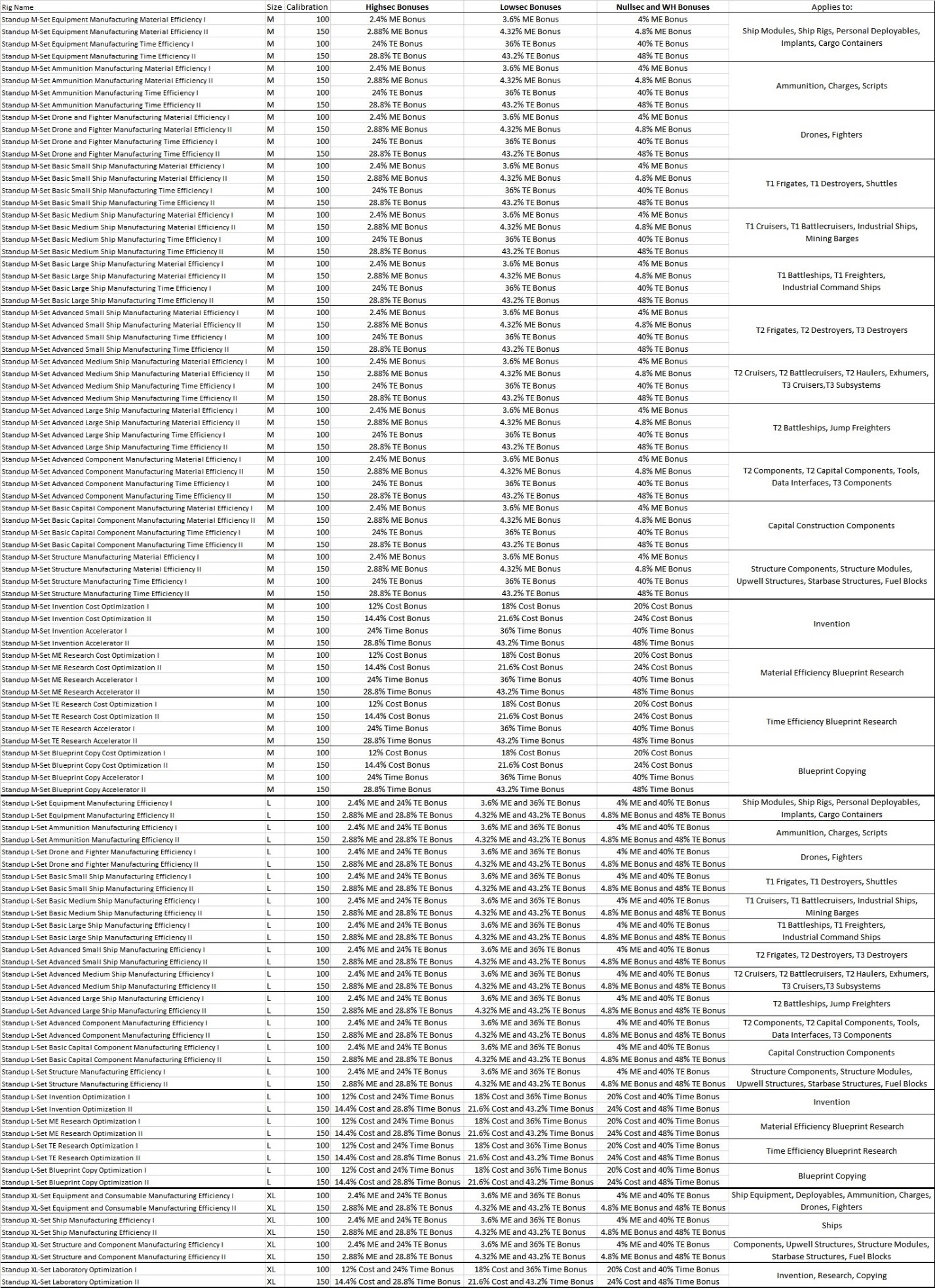
I found on the rig spreadsheet evidence that suggests one can build capital construction components, structure components, and structures themselves in a Raitaru:

So while I can't build capitals in a Medium Eng Plex, I might be able to improve efficiency with a Raitaru after all. More investigation required.

Friday, June 10, 2016

Post Astrahus Production

The flood of Astrahus producers has brought the margins of the market down as predicted and I'm looking at 10% or possibly less for profit per unit. Its even feasible that the competition could drive profits lower than I'm willing to work with. Its all good, capitals are in a good spot and should continue to be profitable.

The real question is what to do next.

One possibility is to try to upgrade to Fortizar production by buying blueprint copies off contracts and taking the hit. I haven't investigated margins but the much higher barrier to entry in the form of the 60 billion ISK blueprint cost might have kept the number of producers low and thus supply lower than demand keeping profit margins high. I need to work up the numbers to be sure.

Another option is to amass capital and try to get in early on the upcoming industrial citadel/drilling platforms re-announced at fanfest this spring:

This autumn will see the introduction of a new class of citadel specialised for industry, and CCP has confirmed that it will come in medium, large, and x-large sizes just like standard citadels and they will be specialised for manufacturing and research. This will come at the same time as mining barge overhauls to improve both their visuals and gameplay, though we don’t have any details yet of exactly what those gameplay tweaks will be.
The winter update could revolutionise the way we collect resources in EVE with the introduction of a new drilling platform class of structure. This is sure to spark wars over moons and asteroid belts and will replace the Starbase in its current role of mining moon minerals. 
If I plan and gather resources properly like I did for the Astrahus project, I could potentially make a lot of ISK again as I expect there will be a lot of demand for these structures as well, perhaps even more than there was for Astrahus.

One thing is for sure, its a good time to be a Planetary Interaction baron because those prices will just keep going up as these things are built.

Monday, April 25, 2016

BB 74 - Building the Future

Welcome to the continuing monthly EVE Blog Banters and our 74th edition! For more details about what the blog banters are please visit the Blog Banter page.

The Most Important Reveal at Fanfest Was......
So when this Blog Banter goes live Fanfest will be over. Hungover geeks from around the world will be departing Reykjavik after a five-day binge of important internet spaceships and partying. Whether you were there in person, watched the streams or read the dev blogs on your mobile hidden under your work desk there was probably something in there that gave you a "nerd-boner". What for you personally was the most important thing to come out of Fanfest 2016?

* * * * *

I'm a sucker for prognostication. I love seeing plans and hints of plans and speculating about what it all means and how I would accomplish them, or change the plans entirely. So the most important things to me were these two pictures from Sand, Cider, and Spaceships blog on Day 3:


These two slides combined tell us the future of EVE and its propagation of user owned structures. 

So we know from above that Manufacturing and Research in outposts and POS are going to be covered Industrial Array structures in the fall. We can also speculate from the round tables and such that the Drilling Platforms for moon mining (and ring mining perhaps?) and reactions are a thing for next year, and I believe I heard that small "Stargates" are going to replace the jump bridges of the current POS networks. Not sure where Cyno Beacons and Jammers will fall, observatories or Admin Hubs? I'm still not sold on the need for Advertisemtn Center structures as per their description from the original dev blog:

H.     Advertisement Centers
Structures mainly aimed toward propaganda spreading.
Service module possibilities: Text advertisement, billboard replacement, being used as gigantic monuments with no purpose (except to show how big your e-peen is by showing the statue of your glorious alliance leader). Could also involve frozen corpses somehow.
Rigs possibilities: Anything affecting what’s above.
Regardless, we know now from fanfest that CCP is pleased with the direction and acceptance of Citadels and will continue to push forward with that vision. This is the most important thing to me to come out of fanfest.